Wednesday, 22 June 2011

". . . never exactly the same and never really different. . . " : Eliane Radigue's Naldjorlak

[image: from Displaced Sounds blog]

It is difficult to imagine how one could experience Eliane Radigue's Naldjorlak except as some sort of consensual hallucination. In its first movement in particular, for solo cello, you find yourself staring at the body of the instrument, transfixed: you can see exactly what the instrument is doing, exactly how the sound is being produced - and yet, you are bamboozled. Sounds seem to be drifting, floating around the room, moving through space, coming at you from behind. Tones that are familiarly acoustic are behaving in ways one would expect only from electronics - with glacial, infinite sustain and purity of tone; then, tones distinctly electronic behave in ways unmistakably organic - ever shifting, fluctuating, ululating. All just from a cello, and one seemingly just playing one note. Tuned, as cellist Charles Curtis claims, to the instrument's 'wolf tone' - "the essential frequency of the cellos' resonating cavity." This is not, as the Deleuzians would say, a becoming-animal, a becoming-machine - but something bodily is happening. An exobiology. First contact. Music for creatures who exist on different time spans from us. Like a swallow hypnotised by the song of a whale.

The composer who, on a trip to the States in the early 70s, bought an ARP 2500 and left the keyboard part behind, uninterested, deals in stretches, distortions of perspective; a delicate yet highly disciplined exploration of the possible timbres to be teased out of very limited material, developed in very close collaboration with her instrument(alist)s, and with great sensitivity, infinite nuance. Music which is, like the quote from Paul Verlaine in the concert programme goes, "never exactly the same and never really different. . . "

Sunday, 19 June 2011

Beethoven's Ninth Symphony - and Zombies!

A scene in George Romero's (1985) Day of the Dead in which we see the zombie affectionately nicknamed 'Bub' grasp his own reflection in a mirrored surface and mime the act of shaving offers both a symbol of Bub's dawning subjectivity and a hint that this third in the sextet is the most Lacanian entry in Romero's career-long attempt to rewrite Sigmund Freud's essay on 'Infantile Sexuality' (from the Three Essays on the Theory of Sexuality) for zombies.

A later moment in his awakening sees Bub listening, on headphones, to a tape of Beethoven's Ninth Symphony. He is clearly caught up short by the music, suddenly rapt, becoming visibly less hunched, less slavering - could we say more refined? Even more human?

Genre cinema, loosely defined, has had a curious relationship to the symphony that Wagner saw as the gateway to the future. The "glorious ninth" is an oft-repeated refrain in A Clockwork Orange (1971), Walter Carlos's day-glo rendition accompanying, and in some ways, in its different articulations, summing up, each stage of Alex's progress. In Dusan Makavayev's (1974) Sweet Movie, we see the Vienna Actionists delightedly singing the 'An Die Freude' as they engage in an orgy of coprophagia. It crops up also in the final scene of Tarkovsky's (1979) Stalker, masked by the noise of a running train, in which, according to Tobias Pontara, it functions simultaneously as the master signifier of rational scientific progress, and a satiric swipe at the very same.

The Ninth is used fairly rarely in cinema compared to the Fifth, or even the Sixth and Seventh - especially if you exclude documentaries and TV movies. And it may be because this quality is never quite absent - of a strident pomposity that can't quite help deflating itself. The Ninth has baggage which, like Alex after his treatment, inevitably makes us a little queasy. But does this self-parodic reflex mean the end of the era - and not just in music - inaugurated by it; or might it still be possible, like Bub, to hear the piece once more with fresh ears?

Wednesday, 8 June 2011

"Sounds like a woman. . . Or a monster!" : Voyage to the Prehistoric Planet


Midway through watching the Roger Corman produced space adventure, Voyage to the Prehistoric Planet (1965, dir. Curtis Harrington), one develops an increasingly odd sensation: the effects seem strangely dated for the year (even for a low budget film), the plot weirdly disconnected, like a series of events strung together with little sense of development - strands are built up, as though they are about to lead somewhere, and then just peter out. And why is the voice-dubbing so off? And is that Russian writing on the side of the spaceship?

Indeed, almost the only thing holding it all together is Ronald Stein's equally uncanny music. Stein was assistant musical director St. Louis Municipal Opera in the early fifties, and married the opera singer Harlene Hiken (who provided the singing voice of Audrey Dalton in a western of the same year, called The Bounty Killer). For several years, Stein served alongside Les Baxter as staff composer at American International Pictures, but though they share credits on numerous films, Baxter claims they never met. With its silken exotica and fleeting electronics, Stein's music for Prehistoric Planet could almost be mistaken for Baxter's at times.

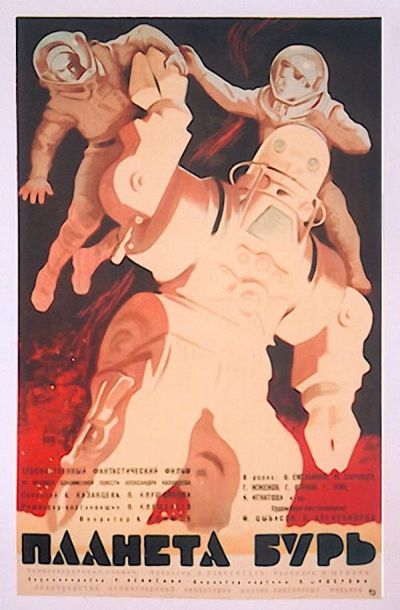
It turns out, Voyage to the Prehistoric Planet was almost entirely composed of footage from an earlier soviet film, Planeta Bur ('Planet of Storms') from 1962, with the story recomposed and scenes re-arranged with the help of a couple of extra scenes starring Basil Rathbone (who would star alongside Dennis Hopper in Harrington's vampires in space flick, Queen of Blood, released the following year). Planeta Bur was directed by Pavel Klushantsev, who shot to fame in Russia when his (1958) Doroga K zvezdam ('Road to the Stars') happened to coincide with the launch of Sputnik.

It doesn't end there though, for the same footage was used one further time, in 1968's debut feature from Peter Bogdanovich (under the alias Derek Thomas), Voyage to the Planet of Prehistoric Women, with Rathbone now replaced with Howard Hughes's former squeeze, Mamie van Doren. Prehistoric Planet now reveals itself as the incoherent, "primordially repressed" middle part of a three-stage fantasy, as in Freud's 'A Child is Being Beaten' - caught between the hard SF of the original Soviet film, and the explicit sexual fantasy of the Bogdanovich version.

In this context, we can now begin to make sense of one of the most troubling aspects of Voyage to the Prehistoric Planet: the suggestive, disembodied voice the astronauts keep hearing as they explore Venus, a tremulous electronic portamento which, as one of the men remarks, "Sounds like a woman. . . or a monster!" Throughout the story, this voice teases the astronauts and audience alike, one constantly expects it to lead somewhere - but it never does. We never really discover its source as the story just sort of peters out. Absent entirely from the original Russian film, and only finally embodied in the third version - here it remains a perfect example of one of Melanie Klein's disembodied partial objects, haunting the spectral soundtrack of the film, and somehow all the more alluring for it. Like a leitmotif from Tristan and Isolde, it constantly resists resolution - to the point of a sado-masochistic impulse that cannot fully annunciate itself, precisely as in the repressed middle term, "Father is beating me."