Showing posts with label Sigmund Freud. Show all posts

Thursday, 15 November 2012

The Name's Bond: Skyfall as Surrealist Allegory

‘Allegedly, the story goes like this.  
Billy Wilder runs into Louis Malle.  This was in the late 60s, early 70s.  
And Louis Malle had just made his most expensive film, which had cost two million dollars.  
And Billy Wilder asks him what the film is about.  
And Louis Malle says, “It's sort of a dream within a dream.”  
And Billy Wilder says, “You just lost two million dollars.”’
                                                   - Steven Soderbergh, in Waking Life


How are we to make sense of the new James Bond film, Skyfall? With its numerous diegetic discontinuities and narrative lacunae, the film seems almost to deliberately resist reasonable exposition. Numerous commenters – on Twitter, IMDB, etc.  – have gleefully pointed out the various continuity "errors" so-called: characters' shoes change colour mid-scene, time distorts and accelerates in strange ways (the final confrontation, for instance, begins and ends at daytime with a whole night passing somewhere in the middle), gloves and scarves and coats disappear and then reappear like ghosts in the night. 

Leaving aside for the time being the fact that Bond comes back from the dead enough times to speaks of "resurrection" as a hobby; the most grievous error seems to me to be the apparent revelation that James Bond's real name is none other than James Bond, son of Andrew Bond. I couldn't care less that this is established by Ian Fleming himself in the late novel, You Only Live Twice; in the context of this film it makes no sense. It is made clear that the name Silva, given to Bond's adversary is a nom de guerre, and the whole menace that Silva poses is his ability to reveal the real names hiding behind the professional aliases of other secret agents in the field. So how can the agent who, in the course of his work, introduces himself repeatedly as James Bond, possibly bear that name on his actual birth certificate except by some preposterous double bluff?

I would like to propose, then, that the most productive way of understanding Skyfall is as the pre-death dream of an agent so absorbed by his own cover that he has entirely forgotten his own identity. In this respect the film resembles the usual understanding of David Lynch's Mulholland Drive, with which it shares a number of themes: doubles and double identities, betrayal and bitter obsession, the need to protect oneself through roleplaying. Skyfall is full of classic dream tropes: old houses, secret tunnels, watching one's place of work burn down, saving mummy. Characters frequently tell Bond that he is tired and needs a rest, recalling Freud's reminder in the Interpretation of Dreams (in the section on the dream of the burning child) that one of the functions of the dream is to prolong the dreamful sleep. There are numerous references to psychoanalysis in the film – the word association game, the all-too-obvious Oedipal triangle – as if to nudge the audience towards such an explanation. Even the way data is visualised (in various scenes involving Q) resembles a middle-aged man's fantasy from the 80s of what the net would one day look like. 

So, to reconstruct the story's fabula from the beginning: we see the agent known as James Bond die, falling from a bridge in Istanbul. The credit sequence featuring Adele and Paul Epworth's song then appears as a kind of hypnagogic hallucination, a confused fantasy of erotic fulfillment and a return to the womb. The rest of the story then arises as a kind of substitute formation to ward off the traumatic possibility of ‘James Bond’ recalling his own real identity. This precisely is the threat represented by Javier Bardem's character Silva (whose name is an anagram not just for the YouTube account "Vials" revealing agents' true names online, but also of "Valis", the intergalactic AI system that Philip K. Dick believed was communicating with him through dreams in the early 70s). 

Silva's threat is then double – both to undermine 007's self-identity as a virile heterosexual man (in the notorious seduction scene on Hashima Island) and also that he might reveal Bond's true name as he has of the other agents. The 'return' to the old Scottish mansion in the last act of the picture only really makes sense as the confabulation of a spurious back story on the part of Bond's subconscious in order to shore up his fragile sense of self by 'proving' that he 'really is' James Bond. Doesn't this rural manor in the end resemble the house in Louis Malle's infamous dream-within-a-dream, Black Moon, in which Cathryn Harrison's Lily escapes from a real war of the sexes to a strange cottage (in fact, Malle's own family estate) full of talking unicorns and naked children singing Tristan und Isolde?

The only true narrative inconsistency still requiring explanation, then, would finally be the unresolved question that must surely have hung in every viewer's mind at the end of the film [and I warn you, from here on there be spoilers]:  why doesn't Albert Finney's bizarrely inserted father substitute, Kincade, die in the end? Everything points towards the logical conclusion that he should die – both from the realistic stand point that, without any combat training, he somehow survives the assault of a small army – even surprising the murderous Silva at one point, who mysteriously declines from shooting him; and, from our own oneiric angle, that Bond's subconscious should require Kincade's death in order to resolve his Oedipal conflict. 

The only logical explanation is that, finally, the whole point of Skyfall is the protection of old patriarchies (represented by the name of the father, Bond – as in Andrew Bond). For what has actually changed at the end of the film – when, realistically assessed, every mission has been failed, what has been achieved? Only this: that Judi Dench's female M has been replaced and MI6 has a new male boss, while the feisty gun-toting female field agent, Eve (played by Naomie Harris), has settled down to a life as his secretary.

Wednesday, 8 June 2011

"Sounds like a woman. . . Or a monster!" : Voyage to the Prehistoric Planet


Midway through watching the Roger Corman produced space adventure, Voyage to the Prehistoric Planet (1965, dir. Curtis Harrington), one develops an increasingly odd sensation: the effects seem strangely dated for the year (even for a low budget film), the plot weirdly disconnected, like a series of events strung together with little sense of development - strands are built up, as though they are about to lead somewhere, and then just peter out. And why is the voice-dubbing so off? And is that Russian writing on the side of the spaceship?

Indeed, almost the only thing holding it all together is Ronald Stein's equally uncanny music. Stein was assistant musical director St. Louis Municipal Opera in the early fifties, and married the opera singer Harlene Hiken (who provided the singing voice of Audrey Dalton in a western of the same year, called The Bounty Killer). For several years, Stein served alongside Les Baxter as staff composer at American International Pictures, but though they share credits on numerous films, Baxter claims they never met. With its silken exotica and fleeting electronics, Stein's music for Prehistoric Planet could almost be mistaken for Baxter's at times.

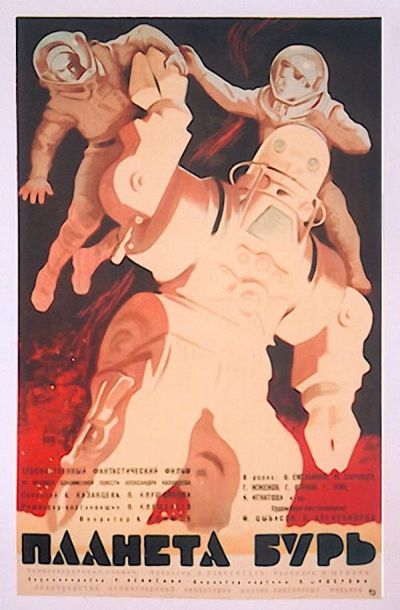
It turns out, Voyage to the Prehistoric Planet was almost entirely composed of footage from an earlier soviet film, Planeta Bur ('Planet of Storms') from 1962, with the story recomposed and scenes re-arranged with the help of a couple of extra scenes starring Basil Rathbone (who would star alongside Dennis Hopper in Harrington's vampires in space flick, Queen of Blood, released the following year). Planeta Bur was directed by Pavel Klushantsev, who shot to fame in Russia when his (1958) Doroga K zvezdam ('Road to the Stars') happened to coincide with the launch of Sputnik.

It doesn't end there though, for the same footage was used one further time, in 1968's debut feature from Peter Bogdanovich (under the alias Derek Thomas), Voyage to the Planet of Prehistoric Women, with Rathbone now replaced with Howard Hughes's former squeeze, Mamie van Doren. Prehistoric Planet now reveals itself as the incoherent, "primordially repressed" middle part of a three-stage fantasy, as in Freud's 'A Child is Being Beaten' - caught between the hard SF of the original Soviet film, and the explicit sexual fantasy of the Bogdanovich version.

In this context, we can now begin to make sense of one of the most troubling aspects of Voyage to the Prehistoric Planet: the suggestive, disembodied voice the astronauts keep hearing as they explore Venus, a tremulous electronic portamento which, as one of the men remarks, "Sounds like a woman. . . or a monster!" Throughout the story, this voice teases the astronauts and audience alike, one constantly expects it to lead somewhere - but it never does. We never really discover its source as the story just sort of peters out. Absent entirely from the original Russian film, and only finally embodied in the third version - here it remains a perfect example of one of Melanie Klein's disembodied partial objects, haunting the spectral soundtrack of the film, and somehow all the more alluring for it. Like a leitmotif from Tristan and Isolde, it constantly resists resolution - to the point of a sado-masochistic impulse that cannot fully annunciate itself, precisely as in the repressed middle term, "Father is beating me."

Sunday, 17 January 2010

"Like a wind-up toy, you stutter at my feet" : Towards an Aesthetics of Stammering

The Shows of London is a small reading group, based out of the King's College English department and interested primarily in the "entertainment and display cultures of nineteenth century London." Last week saw them mounting a half-day symposium in the King's old anatomy museum under the heading 'Stutter London'. London, it seems, has always stuttered, always been noted for its sounds and its machinic rhythms, and this brief conference set out to explore the stammering, spluttering sounds of the city as circulation and disturbance, synaesthesia and unrest. Can we speak of a radical stuttering whilst simultaneously maintaing due sensitivity to those for whom a stammer is a serious impediment?

Sara Thornton, in a presentation on Dickens's Bleak House, evokes Deleuze's paper, 'He Stuttered' in which the stammer is enlisted in the schizoanalytic opposition of the smooth and the striated, and for which, "Style is to stutter in one's own language." She opposes the smooth, oily discourse of Chadband to the ellipses and aporias of Krook, exploiting the potential for innuendo behind stuttering's pathological designation as a 'struggle behaviour'. Louise Lee, however, notes that Charles Kingsley, author of the Water Babies and Westward Ho!, was crippled by a paralysing fear of new and unfamiliar situations as a result of his speech impediment, suggesting that stuttering is perhaps just as likely to be an agent of conservatism as unrest. Kingsley went to great lengths to try and cure his stammer, frequenting the very same Harley Street specialist as another famous British stutterer, Lewis Carroll.
From my own perspective, the most fruitful of the day's interventions were those that drew the notion of stuttering out of the context of the Victorian novel and into the art forms of the twentieth century. Laura Marcus explored the cinematic genre of the 'city symphony' from Cavalcanti's Rien que les heures to Jean Vigo's A propos de Nice, via Ruttman, Vertov and Joris Ivens. The city symphonies of the late twenties sought to project a kind of isomorphism from the urban rhythms of their chosen city to the rhythms of film and montage. As each of the films under consideration were silent, their status as symphonies must be understood as figurative, synaesthetic (Germaine Dulac dubbed Ivens, "One of the visual musicians of the future," and in general it seems to be one of the ironies of history that film-makers tended to forget the close family relationship between music and film at the very moment the cinema becomes sonorised).

As 'symphonic' cinema, it is striking that such city films offer rare examples, for which they were highly praised by Ezra Pound, of a kind of object-oriented cinema (elements of which are taken up later, in very different ways, by Ozu and Tati). It is clear that the only protagonist of such films is the city itself, in which any human subjects are merely subsumed, participants in a rhythm which is not their own. In Ivens's Regen, set, though not obviously so, in Amsterdam, the city, as Marcus pointed out, "knows it is raining." We see the first raindrops strike the canal before we see a man's upturned palm, testing the air for precipitants.
Though containing as much as four months worth of footage, the narrative time span of such films tended to be compressed, in the edit suite, down to the passage of a day. In this respect, we might see them, as was pointed out by a question from the audience, as heirs to the late nineteenth century fondness for using stage lighting effects to recreate the sensations of dawn and dusk, common to Puccini and French realist opera. In other respects, the musical antecedents of Ruttman and Cavalcanti are not opera composers, but the Zukunftsmusikers around Franz Liszt whose programmatic symphonic poems would be the source of Liszt's break with Wagner in the late 1850's.

Following Laura Marcus's presentation, came Tom Fogg's exploration of the craze for 'stutter edit' and similar sounds in what he insisted on describing with the rather unfortunate American term, IDM. Ever since Karlheinz Stockhausen offered his 'Advice to Clever Children' in which, at the prompting of Radio 3's Dick Witts, he compared the repetitive beats of the Aphex Twin to being, "like someone who is stuttering all the time, and can't get words out of his mouth," electronic beats have stammered with an infectious aphasic arrhythmia. The use of the stutter edit in works by Matmos or Caribou, has a kind of anthropomorphic effect on the computer, claims Fogg, while insisting that, perhaps more than any other instrument, the computer was "always already anthropomorphic."
Fogg's paper restricts its attention to the use of specific stuttering software plug-ins in recent computer-based music, his conclusion that stuttering is then a consequence of spread of home computers and their domestification, is thus largely tautological. But what would a general theory of musical stuttering look like? One that would have to go way beyond the rhizomatic glitch techno of the Mille Plateaux label (and their various imitators, discussed by Fogg), to take in Steve 'Silk' Hurley's 'Jack Your Body', Paul Hardcastle's 'Nineteen', the "uh uh uh" of Laurie Anderson's 'O Superman', the voice phasing of Steve Reich's 'Come Out' and 'It's Gonna Rain', even the repeated staccato quavers tht comprise the colloratura of the Queen of the Night's "Der Hölle Rache" aria in The Magic Flute. Indeed, just think how commonly Italian opera singing (perhaps most obviously in Rossini) is characterised by precisely the repetitions, unnatural prolongations, and curiously placed (from a linguistic point of view) cessations that comprise Wikipedia's definition of stammering. And that is just to speak of the most obvious vocal stutterings, whereas Fogg has already shown the possibility of expanding the term to an anthropomorphic description of instrumental and machine-made sounds.

If any piece of music were to, "Der Hölle Rache", one of the most venomous, but also one of the most beautiful, and certainly one of the most difficult to sing arias in all opera, right at the very top of a soprano's range, sits well with Deleuze's notion of a language "so strained that it starts to stutter, or to murmur or stammer ... then language in its entirety reaches the limit that marks its outside and makes it confront silence." But perhaps Fogg is a little overhasty in dismissing the possibility of a psychoanalysis of sonic stammering. In 'O Superman', in 'Nineteen', even in Matmos's A Chance to Cut is a Chance to Cure, don't we find precisely this re-mergence, this return of the repressed - as in the young Freud of his early Studies on Hysteria (co-authored with Josef Breuer), stuttering as hysterical symptom, "effects and residues of excitations which have acted upon the nervous system as traumas." The stammer marks the horror of the past, a nervousness towards the future, and the block of the unsayable.
All images taken from last summer's 'Stutter' exhibition at the Tate Modern.

Sunday, 2 August 2009

Chaos Reigns: Lars von Trier - Antichrist


Twenty-five years after the video nasties act, Lars von Trier's latest film, Antichrist, has shown conclusively that, now at least, the British Board of Film Classification (responsible for drawing up the notorious 1983 list of over 70 banned horror films) is now a more liberal and enlightened judge than the entire critical and juridical establishment of the Cannes film festival. While the BBFC sees Antichrist's more explicit images as "exceptionally justified, in this context, by the manner in which they illustrate the film's themes and the nature of the couple's relationship," the critics and jurors at Cannes found themselves frothing at the mouth in the style of the hapless victims of Lamberto Bava's Demoni, "The film must be stopped!" It may be instructive, in this context, to compare the film to another film by a Danish director from eighty-five years earlier, Benjamin Christensen's Häxan (occasionally subtitled "Witchcraft Through the Ages"). Häxan traverses very similar territory, comparing the treatment of women during the witch trials of early modern Europe to the modern day treatment of women in the psychiatric clinic, and asking, have we really come so far? Like von Trier's film, Häxan is split into chapters and a prologue and freely mixes fantasy and 'reality' (even calling itself a "documentary") without clearly distinguishing between the two. Perhaps von Trier's most astonishing acheivement with Antichrist is to have effectively replayed a scene from Häxan, in which a convent of nuns are seen in the grip of a wild collective hysteria, not in the film itself, but at the Cannes festival, swapping impressionable young nuns for supposedly mature and respectable elder statesmen of the film industry. More recently, I have seen reports on the web of critics who, having booed and jeered with the pack at Cannes, have now seen the film again, and found themselves forced to admit that it really is quite a brilliant film, and wondering quite what came over them at that initial screening. Also, like Häxan, in which the part of the devil is played by Christensen himself, one should be in no doubt as to who the 'antichrist' of the title is - as the sequence of credits makes almost comically clear it is von Trier (perhaps we could even compare the now notorious interview in which von Trier repeatedly attempts to insert the words "is the greatest director in the world" into Willem Dafoe's answers, to a scene in Häxan in which young witches are seen kissing the devil's backside).

Since seeing the film in Paris a few weeks ago, I have become strangely obsessed with reading critical reports on the film, if only because so many of them seem to thoroughly misguided. Christopher Hart's Daily Mail piece, in which he repeatedly calls for the films censorship despite admitting he hasn't seen it, is almost too true to form for the Mail, scarcely even a newspaper, more a comic for Nazis. Even stranger in some ways, was Sean O'Hagan's assertion in The Guardian that the film contains a "critique of psychoanalysis." presumably because at one point Gainsbourg's character says, "Modern psychology has no place for dreams. Freud is dead, right?" Can such an experienced journalist really be so stupid to confuse a line spoken by one of a film's characters with the controlling idea of the film? Especially when everything we see directly contradicts the line? The assertion that "Freud is dead," in a film so full of resurrections and disinterments, is clearly meant to be ironic, and if "modern psychology has no place for dreams" then that is, no doubt, modern psychology's problem, for this film is totally suffused with dream images, and Dafoe's character's complaint of bad dreams is an omen the couple ignore most foolishly. In fact, this film is an attack on the phallogocentrism of 'modern' cognitive behavioural therapy (such is the occupation of Dafoe's character) and psychoanalytic theory is its chief weapon in this attack.

There seems to be a real desire to strike out at von Trier, the arch-provocateur, in a fashion somewhat akin to the tendency of the thick kid in the class to beating up their most openly verbose and intellectually precocious classmates. The insistence on the part of Ads Without Products that the film represents an idealised, Europeanised vision of America because 'real' Americans don't have log cabins in the woods, far from the road, is particularly odd. For if this log cabin reminds us of anything it is nothing in European culture but, of course, Jacques Renault's log cabin (also in the woods of the Pacific Northwest) in Twin Peaks (I also seem to remember that a certain Henry David Thoreau had a little log cabin, far from the road, out by Walden Pond, and James M. Cain inserts just such a cabin into the middle third of Mildred Pierce - but no doubt Cain, Thoreau and Lynch aren't really real Americans either). This is far from the only Lynchian touch in Antichrist (the precise use of close-ups to render familiar objects and body parts strange and uncanny being the most obvious) and no doubt the reference is not accidental. And then there is the gallimaufry of accusations of misogyny, almost entirely from male critics (the one exception - at least as far as I'm aware - being Julie Bindel, who curses the film for the apparent absence of rationale and logos, the very object of the film's critique). Calling this intense and patiently researched analysis of anti-feminism (what other film have you ever heard of feature a credit for "research on misogyny") a misogynist film is of a kind to the recent accusation that comic Richard Herring's current show about racism (entitled "Hitler Moustache") is in fact racist. Is it racist for a white comic to to tackle racism in his show? No, I don't think so. Victims, as Alain Badiou says in his book on St. Paul, have no privileged access to the truth. As Rifa Bhunoo points out, dismissing Herring's show as racist is a means of sidestepping debate, acting as though the issue is no longer relevant or unworthy of serious attention. There is a kind of Boris Johnson logic at work here - cancelling an anti-racism free festival in London on the grounds that London does not have a racism problem and therefore to have such a festival is only inciting racial tension. The horror of these male critics at Antichrist is the horror of castration - the very fear that, according to psychoanalysis, animates man's fear of women. It is for this reason, I believe, that the BBFC had no issues with the film's more graphic moments. The British censor understood that the theme of the film, its subject (but certainly not its intent) was misogyny, and an intensive and in depth exploration of a long history of violence towards women, like Häxan, from the witch trials to the therapautic clinic, and as such to skip or gloss over the fear of castration and the reality of cliterodectomy (emphasized by their structural mirror image: the healthy, thrusting organs of the opening scene) would be almost more offensive than their inclusion.

Sunday, 28 June 2009

"You became a priest because you were too much of a coward to do what I do"

When Eli Wallach's Tuco talks to his brother, the priest, in The Good, The Bad and The Ugly, he sets up a structural equivalence between church and bandit. The central, unspoken third term here, as in Freud's A child is being beaten, is the state. Under Italy's postwar imperfect bipolarism, that left the Christian Democratic party in power, practically unchallenged, from the foundation of the republic after World War Two until the Tangentopoli scandals of the early nineties, there was a very real equivalence between church and state that may well have equivocated criticism of the former for that of the latter (just as when, interviewed in 1994, the year of Berlusconi's first abortive government, Lucio Fluci rails against the censors - "They should censor the news instead of my films" - there was a very real equivalence between the state and the news media). Anti-clerical themes would continue to pervade pulp Italian cinema throughout the seventies. If Fulci and Dario Argento tended to respond somewhat cryptically to accusations of anti-catholic imagery in their films, there is little doubting the intent of the sustained orgy of blasphemy that characterises such films as Bruno Mattei's L'Altro Inferno (ingestion of the eucharist leading a nun to vomit blood; a rotting, worm-ridden head in the tabernacle; nuns boiling babies, etc.).

There is a kind of direct continuity between the spaghetti westerns of the sixties and the gialli of the seventies - and if I use the term giallo in its broader, anglo-american sense, it is because their is an even greater unity between the urban thrillers of the early seventies - gialli proper - and the gore horror of the late seventies. This concatenation is marked most obviously by the music of Ennio Morricone and his repeated use of certain kinds of unorthodox instrumentation (such as the harmonica in Once Upon a Time in the West and L'ultimo treno della notte). In fact there is a remarkable continuity of personnel and production: Lucio Fulci made several westerns before switching to horror and Argento wrote westerns (contributing the memorable opening scene to Once Upon a Time in the West). Leone's editors on the Dollars trilogy, Eugenio Alabiso and Giorgio Serrallonga, went on to work on several gialli, as did their assistant art director (graduating to production designer in the process). Also, the production company behind the Django series went on to make a number of successful gialli. What links these two filoni is this certain reference, alluded to, in relation to gialli, in a previous post, to the Lacanian Real.

Before Jodorowsky's El Topo, Leone had already captured the hallucinatory potential of the desert though the lens flares and dizzying photography of Clint Eastwood's ordeal in The Good, The Bad and The Ugly. The desert becomes itself a character and, like the Overlook Hotel, a merciless one. Driving through a "sidereal" America, Jean Baudrillard describes a desert denoting "the emptiness, the radical nudity that is the background to every human institution . . culture as a mirage . . . The desert is a natural extension of the inner silence of the body. If humanity's language, technology, and buildings are an extension of its constructive faculties, the desert alone is an extension of its capacity for absence, the ideal schema of humanity's disappearance." Preceding the desert of the Real, the Real of the desert; a Real at once compulsive and pulsional, like the undead persistence of a cat re-animated by another's murderous impulses in Il Gatto Nero, the hysteria of murder in Tenebrae, the knot of a memory that refuses reinscription in Profondo Rosso and L'uccello dalle piume di cristallo.

Friday, 17 April 2009

Radio's Uncanny Origins

If Guglielmo Marconi had once considered the possibility of using his wireless telegraph as a means of contacting the dead, it would not be long before the same technology was being put to the service of mass slaughter. Already, by the dawn of the twentieth century, Marconi had demonstrated his new technology to the British and Italian navies and it was not long before it was in regular military use for the purpose of ship to shore communication and, with the invention of the thermionic valve, would prove an essential part of strategy and manoeuvres in the First World War. However, at this time, the use of wireless was still largely reserved for point to point communication and the idea that broadcasting, at that time considered a nuisance side effect of the technology, might become its principal use was largely foreign to those who used it. This was all to change in 1916, during the Irish Easter Rising.

On the 25th April, the day after Easter Monday, as the British troops called in reinforcements and declared a state of marshal law in Dublin, the Irish volunteers made the first broadcast from the post office on Sackville Street, using the same point to point technology to make a diffused message in the hope that their message, the declaration of an Irish republic, would reach the American press (Marshall McLuhan). In the same year, an employee of the Marconi Wireless Telegraphy Company of America called David Sarnoff would suggest to his bosses the possibility of radio becoming a “household utility” much as the piano had been; and so began the domestification of the radio at the very moment of the realisation of its revolutionary potential.

The formation of the British Broadcasting Company in 1922, at the suggestion of the Post Office, was largely a pragmatic attempt both to appease the commercial interests of the wireless manufacturers and to suppress the possibility of unrestrained amateur broadcasting. It was the BBC’s first Managing Director (and, later, first Director-General of the British Broadcasting Corporation), John Reith, who would articulate the philosophy of public service that would come to define the BBC’s mission (with true missionary zeal) in terms of universalism and national unification. Reith’s universalism was threefold, as Georgina Born explains,
First, universal availability: a national service meant that the entire population of the United Kingdom should be able to receive a high-quality broadcast signal. Second, there was a commitment to a form of social and cultural universality, in that the BBC undertook to produce both a regional and a national programme service. The audience was conceived both as a unity and as socially and culturally diverse. The BBC was to be an impartial arbiter, assessing the various constituencies and tastes and responding accordingly. Third, there was a universality of genre in the policy of mixed programming from the outset, BBC radio broadcast a wide range of genres each day and week, including news, talk, sports, drama, religion, light entertainment and a variety of music – both popular and classical. 
Reith’s universalism was centred around a concept of “the best of everything,” conceived as politically neutral and, ultimately, transparent, but which was to prove highly flexible given the different articulations of subsequent Director-Generals. The drawing together of the diverse strands of audiences and programming in the specific manner undertaken by the early BBC was thus responsible for a “new kind of public, commensurate with the whole of society, which it brought into being.” .

The BBC, under the “massive, totalitarian, and idiosyncratic” stewardship of John Reith came to exist in a ‘hegemonic relation’ to the British populace, “the nation [as] one man,” in Reith’s famous phrase - a spectral substitution whereby, “a certain body tries to present its particular features as the expression of something transcending its own particularity.” (Ernesto Laclau) The form of this relationship was through the metaphor of the National Family (David Morley) and the image held in the mind of BBC programme-makers of their audience was of “a family audience, seated round the fireside at home.” The radio thus became instituted, not just as a piece of furniture at the heart of the family home, but as the principal symbolic association between the domestic family and the nation state. At the heart of radio’s familiar homeliness, however, was an unsettling movement of the uncanny.

In Sigmund Freud’s (1919) essay on ‘The Uncanny’ [Das Unheimliche] he lays stress on a certain undecidability to be found in standard dictionary definitions of unheimlich’s apparent opposite, heimlich [homely]. Freud’s dictionary defines heimlich as both the “familiar and agreeable” and “what is concealed and kept out of sight.”. Freud thus sees in heimlich a meaning “which develops in the direction of ambivalence, until it finally coincides with its opposite, unheimlich.”. This precisely is what is at work with regard to the position of the radio in the family home in modern Britain. By bringing the public sphere into the very heart of the private space of the home ), broadcasting created a structural indeterminacy between inside and outside, an intimacy that whispers in your ear, and the exteriority of an actuality constituted through outside broadcasts, summed up by Lacan’s concept of extimité or extimacy. The extimate object is the disembodied voice, which “functions as a strange body… a ghost-like apparition which can never be pinned to a definite visual object;” (Slavoj Zizek) The appearance of the voice, transmitted and transfigured through the ether, was perceived as a kind of uncanny intrusion from the very first radio transmissions, as Harlow describes of an early long distance transmission by R. A. Fessenden on Christmas Eve, 1906,
They listened eagerly, and to their amazement heard a human voice coming from their instruments – someone speaking! Then a woman’s voice rose in sound. It was uncanny!


Briggs, A., The History of Broadcasting in The United Kingdom Volume I: The Birth of Broadcasting, 1961, London: Oxford University Press; 

Cardiff, D. & Scannell, P., ‘Broadcasting and National Unity’, in Impacts and Influences: Essays on Media Power in the Twentieth Century, Curran, J., Smith, A. & Wingate, P. (ed.s), 1987, London: Methuen, pp.157-173;

Morales, C., ‘Radio From Beyond the Grave’, in Radiotext(e), Strauss, N. (ed.), 1993, New York: Semiotext(e), pp. 330-2;Scannell, P. & Cardiff, D., A Social History of Broadcasting – Volume One 1922-1939: Serving the Nation, 1997, Oxford: Blackwell;

Seaton, J., ‘Broadcasting History’, in Power Without Responsibility, Curran, J. & Seaton, J., 1981 [1997],London: Routledge.


Tuesday, 31 March 2009

"Is God in showbusiness too?"

Many thanks to Infinite Thought for linking to Fredric Jameson's (1974) article about Zardoz. Jameson's initial "literary" analysis of Zardoz, as a variation on the Enlightenment critique of religious mystification, might be supplemented by the suggestion that, less a "fable" as Jameson would have it, Boorman's film is a critique of religion which nonetheless takes the form of a religious foundation myth (c.f. Freud's Moses and Monotheism). Sean Connery's Zed first receives his awakening from the pages of a book (albeit Frank Baum's Wizard of Oz and not the holy books and religious scriptures of the Abrahamic religions) handed to him by God-the-Father ("I bred you. I led you."), this then leads him to kill this God-the-Father figure, before, ultimately, leading his people ("the chosen ones") to the promised land of the Vortex, a place of Edenic rural serenity, with the final assault of the 'brutals' against the Vortex dwellers a kind of return of the repressed on the part of this particular Utopia's own structural outside.

Tuesday, 24 February 2009

Revolution 4.5: The Beatles' Vanishing Mediator

The Guardian on the recent discovery of what purports to be take twenty in the recording of the track 'Revolution One' from The White Album, which, bearing both the lyrics and chords of 'Revolution 1' and the so-called 'experimentalism' of 'Revolution 9', acts as a kind of "missing-link" between the two. "Interesting," claims The Guardian's Tim Jonze, "until we find out it's all an elaborate hoax tomorrow." So, is it a hoax or is it for real? Well, the answer is, of course, both. To adopt a favourite trope of Slavoj Zizek's (in, for example, The Plague of Fantasies), it is, rather like the middle stage elaborated by Freud in 'A Child is Being Beaten' ("I am being beaten by my father"), a "construction of analysis" never actually assumed by the subject in question, lacking any positive existence in reality, and precisely as such, identical to the Lacanian Real  - the subject's fundamental fantasy, "the very kernel of the subject's being" (Zizek). This explanation is totally consistent with George Martin's claim, at the time of the release of his son's Love mash-up for Cirque Du Soleil, that there was no more Beatles material to be found in the archive, since, as Freud says quite clearly, this middle stage is "never remembered" by the subject in question. And so, as 'the Real' of The Beatles that must inevitably disappear from sight, what does this track tell us about their oeuvre? Well, the dull, plodding rhythm, the pedestrian I-IV-V chord sequence, the asinine lyrics trumpeting "revolution" but shirking at the possibility of any "destruction" taking place (truly, Robespierre's "revolution without the revolution") - all this we knew already from the version ('Revolution 1') on The White Album - but what is laid particularly bare on this 'new' version is just how little the famed 'experimentalism' of The Fab Four rises above the level of a bunch of stoned frat' boys horsing around with kazoos, 'funny' voices, and tape-reversed standard electric blues riffs. Whereas 'Revolution 9' sounds at times, at least superficially, a little like some of John Cage's tape experiments (such as 'Fontana Mix' from 1958), we can now say, almost for certain, that its constructions lacked any of the rigour and precision of Cage's work. A timely reminder, in the wake of McCartney's recent check-me-out-I'm-so-damn-out-there-man press junket for his latest Fireman album.