Showing posts with label John Cage. Show all posts
Wednesday, 26 August 2015
A Series of Resounding Major Chords: the Third Hang at the FLV
I have a review of the third hang from the collection of the Fondation Louis Vuitton in the new Frieze.
Labels:
Cerith Wyn-Evans,
Fondation Louis Vuitton,
Frieze,
John Cage,
Ziad Antar
Saturday, 12 November 2011
Cage, Stravinsky, the Long Now
"The sooner the world forgets Stravinsky the better," wrote the young John Cage to a friend, in 1935, "If he gave us the primordial, as you say, I swear it was a cheap imitation." Igor Stravinsky, for his part, was scarcely any kinder about Cage. Though the composer of the Sacre du Printemps would admit, in one of his many conversations with his friend, the conductor Robert Craft, to finding some of Cage's work "enjoyable" he admitted, finally, that "his performances are often, to me, the frustration of time itself."
Looking back over the music of the twentieth century, it seems in hindsight that, more than Schoenberg and Stravinsky or Cage and Boulez, the two magnetic poles in terms of style and temperament were indeed Cage and Stravinsky, two composers who could never see eye to eye and for whom there seems scarcely any point of engagement or rapprochement. And it may be, as Stravinsky hints, precisely over this question of time, and of one's mode of being with regard to time, that this fundamental incompatibility is most keenly felt.
So amongst the several concerts of late works by the late John Cage programmed in this year's Festival d'Automne in Paris, it is this pairing of Cage's Seventy-Four (for Orchestra) with Stravinsky's Requiem Canticles at the Cité de la Musique that proves the most fertile. How better, after all, to look back upon a century like the twentieth, by which we are all still so haunted, than to place side by side the means by which two of its musical titans chose to say goodbye to music?
Cage kept on composing until his final year, completing a number of significant works in the last few months before the second stroke that killed him while preparing tea on August 11th, 1992. Of these late 'number works' from his final months, Seventy-Four is on the largest scale and is perhaps the most obviously mournful, even while treading cautiously before applying such a direct psychobiographical correspondence with a composer like Cage. Stravinsky, on the other hand, wrote his setting of the Latin requiem mass some five years before his death in New York in 1971, and already, as his widow would later claim, he "knew he was writing it for himself."
It feels strange still to imagine the motorik sawing of the strings which open the first movement drifting up from the canals of Venice as Stravinsky's body was ferried to the cemetery island of San Michele to be buried near his old collaborator, Sergei Diaghilev. So brittle and crisply locomotive as played tonight by the Symphony Orchestra of the Südwestrundfunk of Baden-Baden and Freiburg, one can scarcely imagine it played in a city without cars.
Only with the sudden violence of the third movement's Dies Irae can we imagine ourselves in Venice - and even then it is the macabre and foreboding Venice of Don't Look Now and Aldo Lado's Chi l'ha vista morire? A Venice of uncanny shocks around mysterious dark alleyways. As we drift into the final three movements with the Lacrimosa, we could be amongst the damp fog of the sirocco, until the postlude brings on the eerie tolling of bells, to the final chords of, in the words of Robert Craft, "death alone".
Cage's Seventy-Four may kick off in an equally misty atmosphere, but it is a mist of a fundamentally different texture. The name of the work comes from the number of musicians: an orchestra of two pianos, two percussionists, one harp, plus strings divided into fourteen first violins, ten second violins, eight a piece of cellos and violas, and six double basses. These seventy-four musicians are further split in two - high and low - with each group being given, less a score, than a series of notes, to be played within a set of vague time-brackets, off the clock and without conductor. A performance note encourages players to exaggerate the "usual imperfection of tuning" between orchestral instruments to give the music imprecise degrees of microtonality.
The grand orchestras of major institutions often have a bit of a problem with Cage; tending either to treat his works with an excessive solemnity that veers on parody, or a kind of jocose levity that could seem like a flip dismissal of something, as Stravinsky hinted, best regarded as not really music. Tonight's musicians from the Sudwestrundfunk are not exempt - indeed, managing somehow to commit both sins at once. Nevertheless, almost despite themselves, they manage to conjure up some wonderfully languid textures, forming a heady oneiric concoction.
With age, Cage's opinion of Stravinsky evidently softened, for a concert of the latter's works conducted by the great man himself forms the backdrop to one of Cage's favourite stories. As Igor lays down his conductor's baton and nods his assent to the crowd's applause, a small boy turns to his mother: "That's not how it goes." This is Cage's "proof", as offered in Peter Greenaway's film, Four American Composers, that listening to recordings can only be a bad thing. The boy was wrong, Cage implies, because, almost by definition, that was precisely how it was supposed to go - because Stravinsky himself was conducting it.
A curious sentiment to hear from Cage, perhaps; the composer of indeterminacy, of the composer's diminished authority. By contrast, at least according to this anecdote, Stravinsky is the composer who knows how his works go; perhaps the last major composer for whom there is never any ambiguity in the score.
This is how we tend to imagine Cage and Stravinsky, it is their image in the popular imagination (think of Mads Mikkelsen's unsmiling mien in Coco & Igor), it is, if you like, Cage's Stravinsky and Stravinsky's Cage, and it is basically what the musicians from the Südwestrundfunk gave us tonight at Cité de la Musique: clipped, terse, precision engineering Stravinsky; and lax, care-free, anything goes Cage. But is this the whole story?
Think for a moment of the relaxed lightness, the moments of doubt and ambiguity revealed here and there in Stravinsky's Conversations with Robert Craft, or those passages - there is at least one in practically every piece he wrote - where the music just seems to get carried away with itself, the levee breaks and everything suddenly bursts free of its shackles for a moment. Think of the meticulous planning and measurement David Tudor - Cage's preferred interpreter - put into his performances of Cage's works, or the millimetre-precise measurements Cage himself left by way of prepared piano instructions.
I'd like to suggest another way of seeing this gap between Cage and Stravinsky, that returns to this question of time with which we opened in the light of another Cage composition: ORGAN2/ASLSP. This work from 1985, the second half of whose title stands for As SLow aS Possible, originally written for piano but soon changed for organ, contains a series of notes to be played, as the name suggests, "as slow as possible". The first organ performance lasted 29 minutes. Since September 5th, 2000 (which would have been Cage's 88th birthday had he not died in 1992), a performance has been ongoing at St. Burchardt's church in Halberstadt, which is due to last, in total, 639 years.
Stravinsky once said that "Music's exclusive function is to structure the flow of time and keep order in it." Herein lies a tacit acceptance - even a celebration - of art's power to impose an artificial before-and-after narrativity on the intangibility of duration. Even as the development of Stravinsky's career betrays a most un-Orphic tendency to look back over his own (and other people's) shoulder(s) from time to time, his is basically a music which goes from A to B, from the past to the future. With Cage we have something different.
I think ASLSP has more than a passing resemblance to Stewart Brand's 'Long Now' project, to build a clock and bury it, that would count ten thousand years. It is often argued that Brand's clock is a call to think seriously about the future. I would argue otherwise. Brand's clock is a bulwark against the future. Taken at absolute face value, the clock of the long now is designed to preserve just that - the long now, the neverending present.
Saturday, 5 November 2011
Music, Sound and Time in Bruno Dumont's Hors Satan
Early on in the new film by former philosophy teacher, Bruno Dumont, Alexandra Lematre's character (identified only as "elle") takes an in-ear headphone from the pocket of her hoodie and slips it in her ear. We, the audience are never made privvy to the music she listens to, but the gesture draws attention to the absence of music in the film. As traditionally defined, there is no music in Hors Satan - no silken Hollywood strings, no pop songs, no diegetic performance, no non-diegetic score. Even the kind of sonic re-structuring usually handled by a sound editor is missing, for Dumont did not hire one.
No music, nor very much dialogue either - and most of that which there is is largely inconsequential. But Hors Satan is not a silent film. Far from it. We hear birds tweeting, cocks crowing, leaves rustling, as well as several more revealing sounds - a camera dolly rolling over its track, the wind blowing against a microphone.
In an interview with Jean-Michel Frodon, the director explains, "We recorded only live and "mono" sounds. What you hear in the film are the actual sounds recorded during shooting. I didn't alter or re-record them. I wish some noises weren't there, but I kept them anyway, stoically. . . The sound material is very rich and untamed. Therefore, when there is a moment of silence, you can feel it loud and clear."
At one moment, after it has been raining, we hear water running over a corrugated iron roof and falling to the ground. The two main characters pause in their journey to watch and listen, and we listen with them. These characters frequently take time out to simply stand still and pay attention to some ambient sound. And even in their absence, the camera will likewise pursue such sounds to their sources, becoming, in the process, a character like them. Sound - and a certain quasi-musical attentiveness to sound - thus subjectivizes, and in so doing constructs an audience that will be willing, like the film's characters to offer a certain attentiveness toward sounds, to give them time, without preconceptions.
How can we describe the sense of time experienced in the films of Bruno Dumont? It is certainly very far from the clock-time of Hitchcock, the almost Taylorist efficiency with which narrative details are revealed and slotted into the perpetual motion machine of the diegesis in North by North West or The Man Who Knew Too Much, for example. We find with Dumont a concern with rhythm and tempo that goes beyond brute functionalism, and there is evidently something musical in this. But neither are we dealing with the languorous time of Apichatpong Weerasthakul, nor the deep time of Bela Tarr, which would be something like the Erfahrung of Walter Benjamin.
Karlheinz Stockhausen once remarked that "Wagner, more than any other western composer, expanded the timing of western music: he would have been the best gagaku composer." While the first half of this statement is undoubtedly true, I'm not so sure about the second half. Think of the constantly held back, teetering sense of anticipation, of desperate yearning for an impossible fulfillment, found in Tristan und Isolde. Perhaps I am wrong, but I suspect this is something foreign to the Japanese gagaku tradition. But maybe not so much to the cinema of Bruno Dumont - even if only to an earlier film such as Twenty-Nine Palms, in which the palpable sense of dread, of waiting for some seemingly inevitable horror hangs suspended in each crawling take, like the infinitely delayed resolution of some dissonance in the middle voices.
Hors Satan is different in this respect. The shot lengths are generally shorter than in his earlier films (though still considerably longer than most mainstream films), the forward motion of the narrative less precipitous. Perhaps this film is closer to the sense of time alluded to in Stockhausen's reference to gagaku.
In his book, Haunted Weather, David Toop, in the midst of a discussion about contemporary Japanese electronica, describes this 7th and 8th century court music which, he says, survives largely unchanged to this day, "So measured in the progress of its percussive markers that it draws the image of a footstep raised to move forward yet caught in a universal power cut, gagaku's timbral consistency is a gaseous astringency of reeds, flutes and free reeds."
Toop quotes William P. Malm's book on Japanese Music and Musical Instruments, which claims that the chords of the sho bamboo reed pipe do not serve the functions of tension and release allotted to western functional harmony, "Rather, they 'freeze' the melody. They are like a vein of amber in which a butterfly has been prepared. We see the beauty of the creature within but at the same time are unaware of a transparent solid between us and the object, a solid of such a texture that it shows that object off in a very special way."
Stockhausen discovered gagaku music when he travelled to Japan in 1966 to complete his Telemusik at the NHK electronic music studios, where composers like Toshiro Mayuzumi and Makoto Maroi had been creating electronic music for over a decade. Mayuzumi would score over a hundred films, including several by Imamura and Mizoguchi, both of whom are renowned for their long takes and slow, refined pacing.
Despite the sometimes austere titles, Mayuzumi's electronic music, such as 1953's X,Y,Z for musique concrète, (contemporary with Pierre Schaeffer and Pierre Henry's concrète opera, Orphée 53), exhibits a kind of delirious playfulness, equal parts hallucinogenic Looney Tunes pandemonium and delirious melodrama, as pitch-shifted horns and bird tweets give way to echoplexed weeping.
Moroi and Mayuzumi's collaborative work, Variations on 7, is, however, more restrained, with a much greater economy of means, while still remaining very different from either the French concrète of Schaeffer and Henry or the sine tone based electronic music of Stockhausen and Eimert in Cologne. "One probably reason why this work seems to compelling and relevant now," says David Toop, "is the directness, the clarity, the sense of pure intent."
And this last seems to me a good description of the attraction of Dumont's film-making. He is one of the few directors working today willing to impose restrictions upon himself, to act with a strict economy of tools and means. Utilising a restricted repertoire of shot lengths, camera heights, and angles. Even if his short lengths were to be reduced much further, there would still be a certain sense of slowness to his film because there is none of the usual digital busyness of superimposed sonic and visual detail (/clutter). He does this without nostalgia: there is nothing old-fashioned looking - or sounding - about his films. But there is this sense of "propriety" as he says of Alexendra Lematre's performance. And the drama comes from the disproportion between this propriety, this certain holding back, a resistance to express even, and the sometimes quite startling events which unfold; events which in another context, filmed in another way, might seem, as Dumont says in the above cited interview, quite normal. This is the source of Dumont's "slap in the face"; a slap which is in many ways very musical. Like a snare drum erupting in the midst of a performance of John Cage's 4'33''.
Monday, 15 November 2010
The Merce Cunningham Dance Company - Roaratorio, at the Theatre de la Ville, Paris; November 13th, 2010

If dance is the pre-eminent art of the body, the body unalloyed in its beauty, and unadorned by technology; in the choreography of Merce Cunningham, we find the body transfigured and transcended, to the point where, as in the philosophy of Donna Haraway, the line between the human and its android doppelganger becomes blurry to the point of indistinguishability. Not just Olympia, the mechanical doll from Offenbach's The Tales of Hoffman (as filmed, perhaps, by Powell and Pressburger), but a whole stage full of dancing automatons have been released from their box. But never have these clockwork figures appeared so tender, so pliable. Choreographed by Danceforms software to programme bodies imaginable only through wetware, we find the human at its most subjective in its transcendence, its communion with objects.
Elements of classical ballet, the modern dance of Cunningham's mentor Martha Graham, and -this being a "circus" on Finnegan's Wake - Irish dancing of the Riverdance variety, converge in occult combinations; finding impossible correspondences and convergences, spinning gold from base metal. From this seeming unrelatedness, elements adrift on an even plain, the eye picks out details and attractions at its own pace. Accepting the inevitable partiality of its position in space (as the ear must equally, in listening to Cage's accompanying music), one regards the whole more as one views a vast canvas, and with scant reference to the standard narrative expectations of classical ballet.
Structure emerges as if by accident, with the beauty of DNA, ant farms, or fractals. From moments of the strictest discipline spills the most casual intimacy; machinic rigour thus become inseparable from the simplest, most human of gestures. Even the stools, their cushions in the same colours as the dancers' clothes, are arranged, as if to emphasise the very objectness of the human figures, in the same holds and wild combinations as the coryphées themselves. The world of Roaratorio - and a whole world it most certainly is - is one in which tension and release, the animate and inanimate, form four points of a highly unstable Greimasian semiotic square which are constantly changing places with each other. This is why the dance does not 'mean' anything. It is not a work whose 'deeper' hidden truth can be divined or interpreted. Everything is on the surface, teeming with life. This is the sense in which, with Cage and Cunningham, artworks move from the romantic position of imitating natural phenomenon to operating themselves according to nature's own way of working. Without purpose, unpredictable, yet strangely fascinating.
(Photo credit: Merce Cunningham Dance Company/Bernand)
Tuesday, 6 April 2010
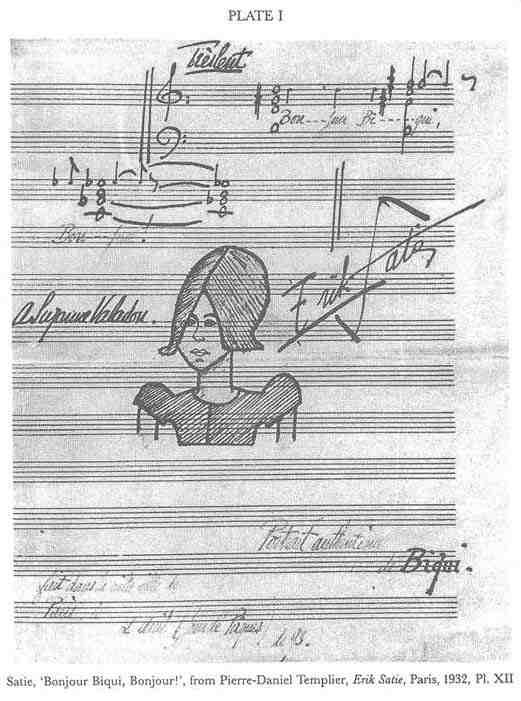
"To play this motif 840 times in succession, it would be advisable to prepare oneself beforehand, in the deepest silence, by serious immobilities."

"Well, you get the idea, right ladies and gentlemen?" demanded the "major proselytising force" Charles Hazlewood, conductor of the BBC Concert Orchestra, after pianist Tim Carey had completed just one round of the single page score of Erik Satie's Vexations. Well, no, quite frankly, I'm not sure if that quick once over was entirely sufficient to convey the extraordinary perversity of Satie's performance instructions which at least imply that a correct performance would involve a total of 840 repetitions.
Peter Evans, a pianist who attempted, in 1970, a solo performance, gave up after fifteen hours, complaining the piece was wearing away at his mind away, and that "things" had started peering out at him from the score. He warned that anyone who might consider attempting to play the piece in the future, would do so "at their own great peril" rather in the style of a wise old man at the beginning of a horror film. A year later, Gavin Bryars and Christopher Hobbs got through the whole thing at Leicester Polytechnic. They compared the piece to 'the end of the world', "like falling asleep while you're driving along the motorway," claimed Bryars.
Vexations was a piece of music largely unknown, from its creation sometime around 1892 until Henri Sauguet, the composer friend of Satie's, introduced the piece to John Cage. Cage would come to be closely associated with the piece and its rehabilitation through a series of group performances, the first of which was in 1963 and involved the participation of John Cale, Christian Wolff, Philip Corner and James Tenney. But even Cage initially considered the piece unendurable, asking, "Why give it a thought?" in a 1958 article for the Art News Annual.
Since Cage's inaugural performance, some seventy years after the piece's composition, the piece has been the subject of vast swathes of serious critical reflection, despite the frequently made conjecture that the whole thing was just a characteristically mischievous gag. Steven Moore Whiting cites the unusual and confusing spelling of each note (there are an awful lot of double flats, b sharps, and so on), as evidence that Satie's piece is a quatrain holorime, in the manner of Jean Goudezki. For Robert Orledge it presents an early example of Webernian serial hexachords, whereas for Robert Maycock, writing in the free brochure given out at the BBC Concert Orchestra's event last week, Vexations is the augur of minimalism.
I have a copy of Vexations on vinyl, released by Philips and performed by Reinbert de Leeuw. As a record, it makes a curious artefact, featuring the same phrase, repeated over and over again on both sides. Ideally, I suppose, you would need two copies and a set of decks in order to get the full effect. Nonetheless, I occasionally put the needle into its grooves, thinking its dissipated, plangent tones might just make pleasing background sound whilst I write on my laptop or read a book. It rarely takes long before I have to either turn it off or simply forget about whatever else I was trying to do and focus all my attention on the music. It is a piece strangely resistant to reduced listening. Like an itch, it demands your attention, or crawls through your skin unbearably.
Labels:
Christian Wolff,
Erik Satie,
Gavin Bryars,
James Tenney,
John Cage,
John Cale,
Philip Corner
Saturday, 12 December 2009
"As if I no longer recognised myself in my own existence ... " Sophie Calle at The Whitechapel Gallery

My first encounter with the French writer, photographer and conceptual artist, Sophie Calle, was, perhaps appropriately, as a fictional character. Maria Turner, a figure in Paul Auster's novel, Leviathan, is a conceptual artist who bears a striking similarity to Sophie Calle. Several of her works are described in the novel, some of which - following and photographing strangers in the street, piecing together a man's life by following the leads of an address book found in the park, &c. - had already been carried out by Calle. Others - such as The Chromatic Diet, a colour-coded nutritional regimen for each day of the week - had not, but once Calle read the book, she decided to "be like Maria" and carry out these additional tasks, even writing to Auster and inviting him to "invent a fictive character which I would attempt to resemble" (Auster demured, offering instead a series of suggestions on "how to improve life in New York City").


Leviathan was not the first time Sophie Calle had become the object of another's narrative. In 1980, Calle had her mother hire a private detective to follow her around Paris. The resulting reports and photographs became a project, The Detective, in which Calle, conscious of being trailed, leads her tail round various favoured, or otherwise meaningful, spots about Paris. As in Double Game, the book Calle authored containg those works of hers which either inspired, or were inspired by, those of Maria Turner; the detective's story, in which Calle is a character, then becomes part of another, broader narrative, being told by Calle herself. She becomes the architect of her own fictionality, and like Serge Doubrovsky, inventor of 'autofiction', is swallowed by her own text.
In her latest work, Take Care of Yourself, it is the text itself that is swallowed in a web of interpretations: a break-up email is analysed and interpreted by over one hundred women specialists, from jurists and psychiatrists, to pop singers, actresses - even a parrot (which literally eats its words). As each successive approach redoubles the text, adding layers of complexity to its meaning, the letter itself disappears - most literally in the work of a proofreader, from whose biro scribbles and highlighter blobs, the original text has been removed, leaving a kind of day-glo Mondrian in its wake. "She has lost herself in the other's traces," said Baudrillard of his former pupil. He sees in Calle's stalking a kind of game, constantly on the edge of seduction - and murder. "To shadow another is to give him, in fact, double life, a parallel existence. Any commonplace existence can be transfigured (without one's knowledge), any exceptional existence can be made commonplace. It is this effect of doubling that makes the object surreal in its banality and weaves around it the strange (eventually dangerous?) web of seduction."

Still their lurks about Sophie Calle something of Francisco Lopez's attack on the Cagean philosophy of music, "The main point is always - and in a very essential sense - about the way music is made, about the procedure. And this is a misleading distraction for music. It distracts the attention of music practicioners (creators, perceivers or whatever) from the actual music to the way it has been made. The procedure becomes a value in itself, for its own sake." I was always fascinated when I would hear stories about Sophie Calle's work, but actually going to the Whitechapel Gallery to 'witness' them first hand left me a little nonplussed. I didn't need to see Feist looping her own voice through a Vox practice amp nor did it enrich my understanding of the work. Indeed we are clearly not supposed to pay too much attention to every last exhibit, every last performance, rather to be bludgeoned by their sheer volume. Calle's work exists best as a story passed amongst friends rather than anything you might really point to and call a 'work'. She becomes then a kind of mythical figure, someone people tell stories about, and about whom stories are invented and passed on. "He understood," says Maria Turner in Leviathan, "that all my pieces were stories, and even if they were true stories, they were also invented." In the end, the true fiction is Calle herself.
Friday, 17 April 2009
A Very Brief History of the Piano
Subscribe to:
Posts (Atom)