Showing posts with label John Cale. Show all posts

Monday, 31 October 2011

I've Got a Secret and Avant-Garde Music


"It's September 16th, 1963 and John Cale is walking onto the stage of a television studio in New York City. "That was one repressed individual," recalls the older, less repressed John Cale over the phone from his studio in Los Angeles, nearly half a century later, "Very uptight." Back in 1963, Cale in a dark velour suit jacket and tie takes a seat next to the show's host, Garry Moore and whispers into his ear, "I performed in a concert that lasted eighteen hours." The point of the show was that the four panellists had to work out the guest's 'secret' from a series of yes and no questions.

"Does it have anything to do with endurance?" asks former Miss America, Bess Myerson."

The above is an extract from my recent interview with John Cale, for The Quietus. But three years later, on the 12th of December 1966, another episode of the same show featured Victor Borge, one time "clown prince of Denmark" withholding the secret, "I'm going to play a song by touching ten pretty girls". The electronic device utilised by Borge for this most extraordinary rendition of 'Dark Eyes' is called a Peopleodeon and was invented by none other than Bruce Haack, along with his friend Ted Pandel, both of whom make a brief appearance at the end of the episode.


Former pianist with The Swing Tones, Haack met Pandel at the Julliard school in the fifties. This episode from I've Got A Secret was broadcast somewhere between Haack's various electronic records for children, made in collaboration with dance teacher, Esther Nelson - Dance Sing & Listen and The Way Out Record for Children - and later (even) more psychedelic stuff like Electric Lucifer and Haackula.

Without any real training in electronics (his degree from the University of Alberta was in psychology), and showing disdain for such ncieties as circuit diagrams, Haack gamely hacked together his own electronic instruments out of guitar effects pedals, battery-powered radios and any other bits and bobs he could lay hands on. These oddments were then put to the service of instructional dance records for children.

The question is, what on earth was a man like this doing on I've Got a Secret, a mainstream American panel show, hosted by Steve Allen and created by comedy writers Allan Sherman and Howard Merrill as a sort of cheap knock-off sister show to What's My Line? How much of another world does the sixties seem when we discover that such a workaday network product, otherwise notable for its brief appearance in the 1959 Doris Day vehicle It Happened to Jane, would feature incursions from John Cale playing Erik Satie's Vexations and Bruce Haack's homemade electronic instruments? Can you imagine comparable guests being introduced in the midst of Ant & Dec's Push the Button?

Tuesday, 6 April 2010

"To play this motif 840 times in succession, it would be advisable to prepare oneself beforehand, in the deepest silence, by serious immobilities."

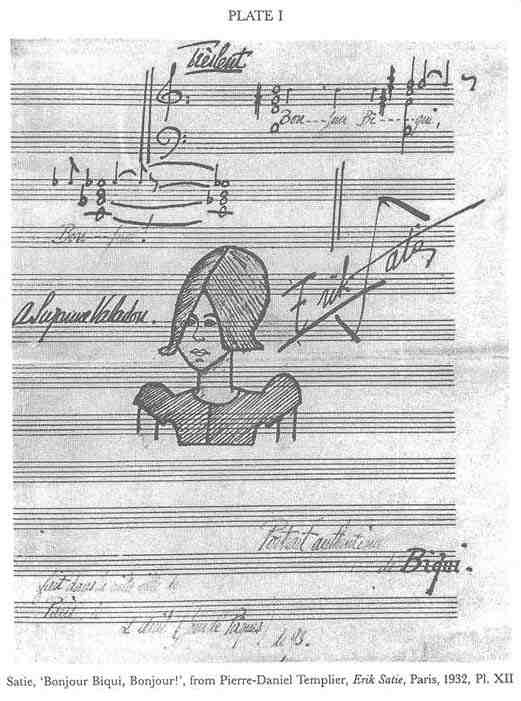
"Well, you get the idea, right ladies and gentlemen?" demanded the "major proselytising force" Charles Hazlewood, conductor of the BBC Concert Orchestra, after pianist Tim Carey had completed just one round of the single page score of Erik Satie's Vexations. Well, no, quite frankly, I'm not sure if that quick once over was entirely sufficient to convey the extraordinary perversity of Satie's performance instructions which at least imply that a correct performance would involve a total of 840 repetitions.

Peter Evans, a pianist who attempted, in 1970, a solo performance, gave up after fifteen hours, complaining the piece was wearing away at his mind away, and that "things" had started peering out at him from the score. He warned that anyone who might consider attempting to play the piece in the future, would do so "at their own great peril" rather in the style of a wise old man at the beginning of a horror film. A year later, Gavin Bryars and Christopher Hobbs got through the whole thing at Leicester Polytechnic. They compared the piece to 'the end of the world', "like falling asleep while you're driving along the motorway," claimed Bryars.

Vexations was a piece of music largely unknown, from its creation sometime around 1892 until Henri Sauguet, the composer friend of Satie's, introduced the piece to John Cage. Cage would come to be closely associated with the piece and its rehabilitation through a series of group performances, the first of which was in 1963 and involved the participation of John Cale, Christian Wolff, Philip Corner and James Tenney. But even Cage initially considered the piece unendurable, asking, "Why give it a thought?" in a 1958 article for the Art News Annual.

Since Cage's inaugural performance, some seventy years after the piece's composition, the piece has been the subject of vast swathes of serious critical reflection, despite the frequently made conjecture that the whole thing was just a characteristically mischievous gag. Steven Moore Whiting cites the unusual and confusing spelling of each note (there are an awful lot of double flats, b sharps, and so on), as evidence that Satie's piece is a quatrain holorime, in the manner of Jean Goudezki. For Robert Orledge it presents an early example of Webernian serial hexachords, whereas for Robert Maycock, writing in the free brochure given out at the BBC Concert Orchestra's event last week, Vexations is the augur of minimalism.

I have a copy of Vexations on vinyl, released by Philips and performed by Reinbert de Leeuw. As a record, it makes a curious artefact, featuring the same phrase, repeated over and over again on both sides. Ideally, I suppose, you would need two copies and a set of decks in order to get the full effect. Nonetheless, I occasionally put the needle into its grooves, thinking its dissipated, plangent tones might just make pleasing background sound whilst I write on my laptop or read a book. It rarely takes long before I have to either turn it off or simply forget about whatever else I was trying to do and focus all my attention on the music. It is a piece strangely resistant to reduced listening. Like an itch, it demands your attention, or crawls through your skin unbearably.